Artificial Intelligence has moved well beyond experimentation. Across industries, leaders are actively testing, implementing, and scaling AI solutions to improve efficiency, decision-making, customer understanding, and innovation. Yet as the technology advances at an extraordinary speed, many organizations are discovering that success depends less on the tools themselves and more on how they are applied.
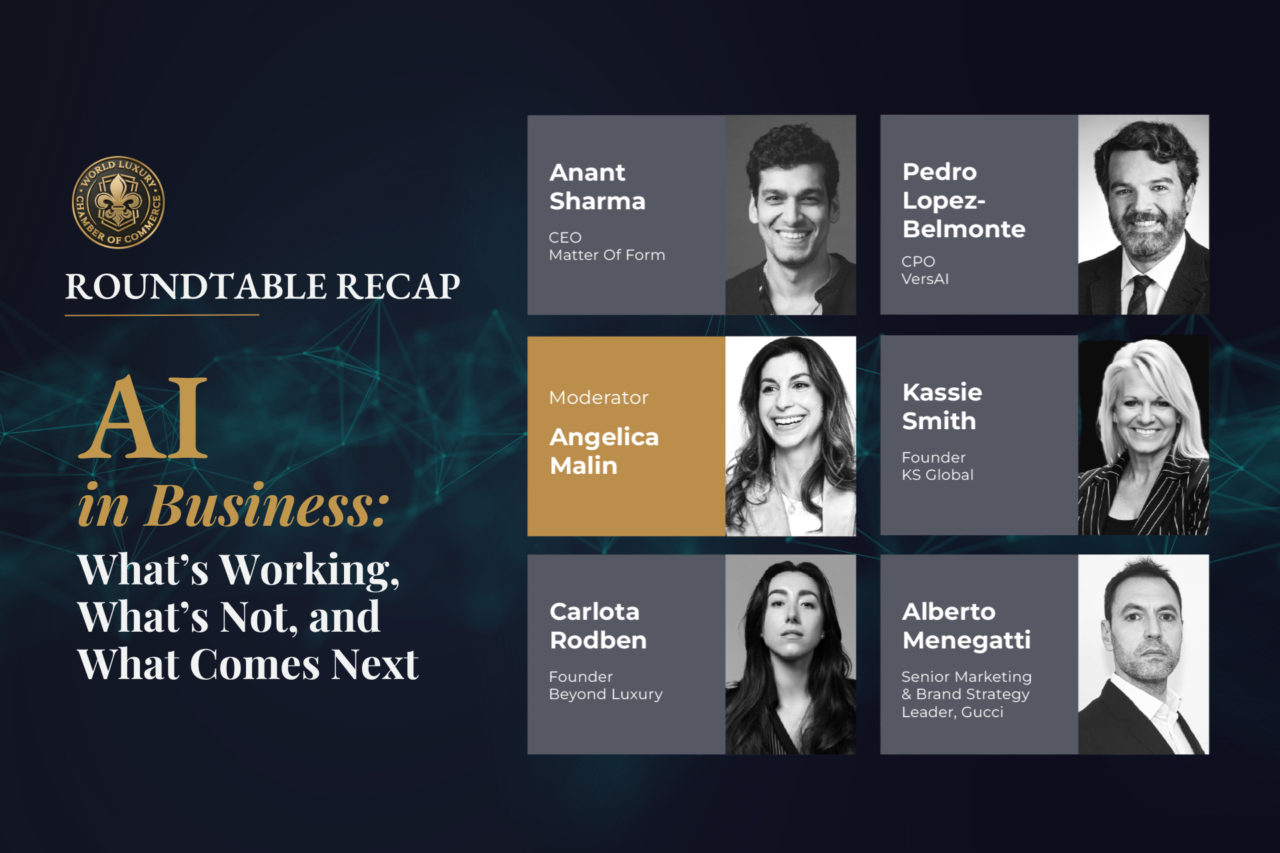
As part of the WLCC AI Lab, the executive roundtable AI in Business: What’s Working, What’s Not, and What Comes Next brought together a diverse panel of luxury, technology, marketing, innovation, and brand leaders to explore where AI is creating real business value today.
Moderated by Angelica Malin, the discussion featured insights from Anant Sharma, Founder & CEO of Matter Of Form; Carlota Rodben, Founder of Beyond Luxury; Pedro López-Belmonte, Chief Product Officer at VersAI; Kassie Smith, Founder of KS Global; and Alberto Menegatti, Senior Marketing & Brand Strategy Leader at Gucci.
Rather than focusing on hype or theory, the conversation explored real-world applications, lessons learned, challenges encountered, and the opportunities emerging as AI continues to influence the future of luxury, customer experience, brand strategy, and business transformation.
Here are the key insights that emerged from the discussion.
1. AI Delivers the Greatest Value When It Enhances Expertise
One of the most practical applications discussed was the creation of organizational “second brains” that capture years of expertise, research, conversations, and institutional knowledge.
Rather than replacing specialists, AI is helping organizations access and utilize accumulated knowledge more effectively. Experts can retrieve insights from years of work in seconds, improving both efficiency and consistency while preserving valuable intellectual capital.
The consensus was clear: AI works best when it amplifies expertise rather than attempts to replace it.
We’ve turned that into a second brain that we can query for insight.
Anant Sharma, CEO, Matter Of Form
2. Historical Knowledge Is Becoming More Valuable, Not Less
Several speakers highlighted that AI becomes significantly more powerful when combined with historical data and experience.
Organizations are increasingly using AI to connect decades of accumulated knowledge with real-time information, allowing them to identify patterns, predict outcomes, and make more informed strategic decisions.
The future belongs not only to those with the most data, but to those who can successfully combine historical wisdom with contemporary intelligence.
You’re taking historic knowledge from people that have actually done it historically, maybe 20 years ago, two decades ago. And then you’re bringing it forward.
Kassie Smith, Founder, KS Global
3. Customer Understanding Is Becoming More Sophisticated
Luxury brands have always relied on understanding customer motivations, but AI is creating new opportunities to analyze behaviour, emotions, unmet needs, and decision-making patterns at scale.
The discussion highlighted how AI can help brands better understand why customers behave the way they do, enabling more personalized experiences and more relevant engagement strategies.
Importantly, the goal is not simply more personalization, but a deeper understanding.
The opportunity is not simply understanding behaviour, but understanding desire.
Carlota Rodben, Founder, Beyond Luxury
4. AI Is Helping Organizations Bring Customer Personas to Life
Traditional customer personas often become static documents that are rarely used after they are created.
Panelists shared examples of using AI to create dynamic, interactive customer profiles that can simulate real customer perspectives, challenges, motivations, and behaviours.
These tools help align teams across entire organizations around a shared understanding of who they are serving and what matters most to their customers.
You can bring personas to life and actually interact with them.
Anant Sharma, Founder & CEO, Matter Of Form
5. Luxury Brands Must Avoid the “Sea of Sameness”
One of the strongest warnings from the discussion was the risk of homogenization.
The luxury industry has already experienced this in digital commerce, where many online experiences have become nearly identical regardless of brand positioning.
As AI-generated content and experiences become more common, organizations face a similar risk. Brands that rely too heavily on standardized AI outputs may lose the distinctiveness that creates emotional connection and competitive advantage.
Differentiation remains essential.
The danger is that we end up creating a sea of sameness.
Carlota Rodben, Founder, Beyond Luxury
6. Human Judgment Remains Irreplaceable
While AI can accelerate analysis and generate recommendations, panelists repeatedly emphasized that strategic decisions must remain human-led.
Vision, intuition, creativity, and the ability to make nuanced judgments remain uniquely human strengths.
AI can provide information and options, but leadership still requires human interpretation and decision-making.
The future is not human versus AI. It is human judgment supported by AI.
AI is not here to replace human, but rather to extend it.
Pedro López-Belmonte, Chief Product Officer, VersAI
7. Relationships Continue to Define Luxury
Across sectors, from fashion and hospitality to real estate and customer experience, participants agreed that relationships remain the foundation of luxury.
Technology may streamline operations and improve efficiency, but luxury ultimately depends on emotional connection, trust, and meaningful human interaction.
The final customer experience must continue to feel personal, authentic, and human.
The human interaction is, in most cases, what gives the value added.
Alberto Menegatti, Senior Marketing & Brand Strategy Leader, Gucci
8. AI Should Support the Journey, Not Replace It
An important distinction emerged during the discussion: AI can create tremendous value throughout the customer journey, but not every touchpoint should be automated.
Brands should identify where AI can remove friction, improve relevance, and enhance efficiency while preserving moments where human interaction creates emotional value.
The most successful organizations will design experiences where technology and humanity complement each other.
Technology should enhance the experience, not replace the relationship.
Pedro López-Belmonte, Chief Product Officer, VersAI
9. Internal Transformation Is Often More Important Than External Innovation
One of the less obvious but highly practical applications discussed was the use of AI to drive organizational change.
Many established brands struggle not because they lack innovative ideas, but because they struggle to bring people along on the transformation journey.
AI is helping organizations communicate vision, align teams, tell internal stories more effectively, and build cultural buy-in around change initiatives.
In many cases, the greatest challenge is not technological adoption but human adoption.
10. AI Is Becoming a Powerful Tool for Strategic Storytelling
Several speakers highlighted AI’s ability to help organizations synthesize complex information into compelling narratives.
Whether communicating with customers, employees, or stakeholders, storytelling remains one of the most powerful leadership tools.
AI can help uncover patterns, surface insights, and organize information, but effective storytelling still requires human context, perspective, and emotional intelligence.
11. Discipline and Verification Are Becoming Critical Skills
As AI adoption accelerates, organizations must establish clear governance and validation processes.
Panelists stressed the importance of understanding where AI should be used, where it should not be used, and how outputs should be reviewed before implementation.
Success increasingly depends on disciplined usage rather than unrestricted experimentation.
Organizations that develop strong verification practices will build greater trust and achieve better outcomes.
12. The Human Voice Must Not Be Lost
Perhaps the most thought-provoking discussion centered around authenticity.
While AI can generate content, summarize ideas, and mimic styles, participants expressed concern that overreliance on AI could dilute individuality and human expression.
Luxury brands, in particular, derive value from distinct perspectives, creativity, craftsmanship, and emotional resonance.
The challenge for business leaders is ensuring that AI enhances human capabilities without eroding the personal voices, relationships, and creativity that make brands meaningful.
AI is going to make us more human than ever.
Carlota Rodben, Founder, Beyond Luxury
Looking Ahead
Perspectives from the Panel
- Anant Sharma: AI as a knowledge engine and organizational second brain.
- Carlota Rodben: Preserving desire, emotion, culture, and differentiation in an AI-driven world.
- Pedro López-Belmonte: AI as an extension of human capability, supported by governance and trust.
- Kassie Smith: Unlocking the value of historical knowledge by combining decades of expertise with real-time intelligence.
- Alberto Menegatti: Protecting human relationships and authenticity in luxury experiences.
The roundtable concluded with a balanced view of the future. AI is already creating measurable value across customer experience, knowledge management, strategic planning, communication, and operational efficiency. However, the technology’s greatest impact may come not from replacing people, but from helping people perform at a higher level.
For luxury brands especially, the future will belong to organizations that successfully combine technological intelligence with human insight, emotional understanding, creativity, and trust.
AI may change how businesses operate, but the qualities that define exceptional brands remain fundamentally human.
WLCC regularly features conversations and insights from global luxury leaders. Join our community to receive new interviews, perspectives, and event invitations: https://worldluxurychamber.com/wlcc-community/.