How will Digital Product Passports, AI agents and new forms of online commerce change the way luxury brands build trust and serve their clients?
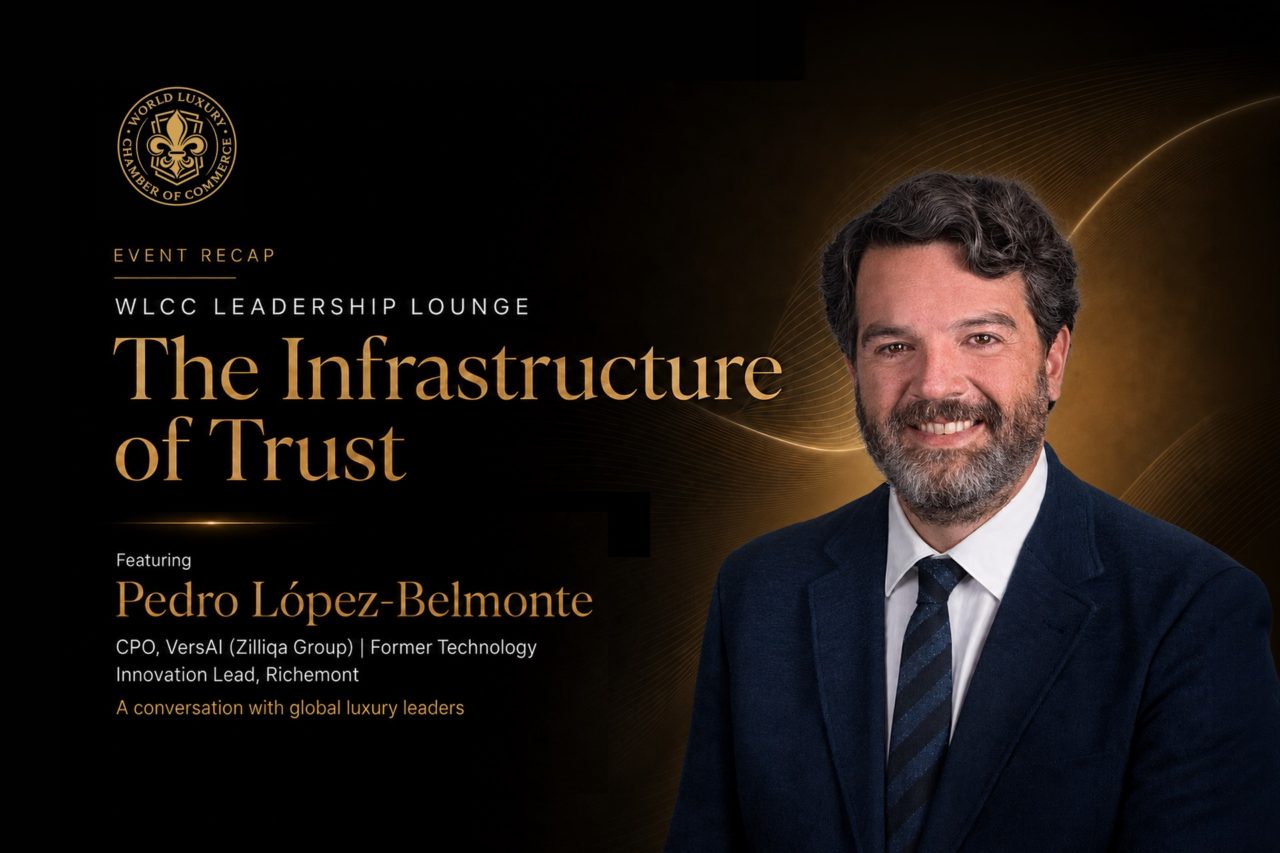
This question was at the heart of the latest WLCC Leadership Lounge, featuring Pedro López-Belmonte, Chief Product Officer at VersAI, part of the Zilliqa Group, and former Technology Innovation Lead at Richemont.
Drawing on more than 25 years of experience in technology and innovation – including 12 years working within Richemont – Pedro offered participants a practical look at technologies that are rapidly moving from experimentation to implementation across the luxury industry.
Having helped pioneer Digital Product Passports across watches, jewelry and fashion, Pedro brought a rare perspective grounded not only in emerging trends, but in the realities of building and scaling these solutions within leading luxury organizations.
A Forum for Learning, Exchange and Business Connection
The WLCC Leadership Lounge is a private virtual gathering designed to connect leaders from across the global luxury industry and create opportunities for knowledge exchange, trusted relationships and business growth.
Each 90-minute session begins with an expert-led fireside conversation, followed by curated executive introductions and an open group discussion. Every participant has an opportunity to present their business, share the partnerships or opportunities they are seeking and exchange perspectives with fellow leaders.
Following the event, participants receive access to the WLCC Business Wall, featuring the profiles and contact details of those who attended. This allows conversations initiated during the session to continue and develop into meaningful professional relationships and potential collaborations.
Digital Product Passports: From Compliance to Client Value
Pedro described a Digital Product Passport as a digital identity connected to a physical product, usually accessed through a QR code or NFC chip.
It can provide verified information about the product’s materials, origins, manufacturing, environmental impact, certifications, care requirements, repair options and eventual reuse or recycling.
While evolving European regulation is accelerating the adoption of Digital Product Passports, Pedro encouraged brands to look beyond compliance.
A DPP can become a direct connection between the brand, the client and the product the client owns. It can support authentication, product registration, maintenance, repair, transfer of ownership and resale – creating opportunities for the relationship to continue long after the initial purchase.
However, implementing a DPP involves much more than adding a digital label. Brands must understand where their product information originates, who owns it and how it moves between suppliers, production, logistics, commerce and after-sales teams.
The underlying data and operational transformation may ultimately prove more significant than the technology visible to the client.
The Client Does Not Value the Passport – They Value What It Enables
One of the most important insights from the conversation was that clients are unlikely to engage with a Digital Product Passport simply because it exists.
They will use it at specific moments when it provides meaningful value: authenticating a product, learning about its story, arranging a repair or preparing it for resale.
For this reason, brands should not measure success only through frequency of access. What matters is whether the passport provides a trusted, useful and seamless experience when the client genuinely needs it.
Pedro also shared how digital passports can connect products with exclusive experiences. A passport can preserve photographs, stories and milestones associated with ownership, creating an enduring link between a physical object, the experience surrounding it and the community connected to the brand.
Agentic Commerce: Bringing the Boutique Conversation Online
The discussion then turned to agentic commerce – a new model in which clients can discover and purchase products through natural conversations with AI agents.
Instead of navigating categories and filters, a client might explain:
“I need something for a summer wedding.”
“It should work with this jacket.”
“I prefer natural materials.”
“This is my budget.”
The AI can interpret not only what the client wants, but also the context behind the request.
Pedro explained that this emerging ecosystem is likely to involve two complementary types of agents.
Third-party agents, including general AI platforms and personal shopping assistants, can help clients research the market, compare alternatives and create a shortlist.
Brand agents can then provide deeper expertise, answer detailed questions, check availability, arrange appointments, prepare a shopping cart, connect the client with a human advisor and support post-purchase services.
The journey may begin with an independent AI platform but transition to the brand’s own environment, where the relationship can become more personal and valuable.
Reliable Data Will Determine Which Brands AI Can Recommend
Agentic commerce depends on accurate, complete and consistent product information.
AI cannot confidently recommend a product or service if important details are missing or if prices, materials, availability and specifications differ across websites, marketplaces and partner channels.
Inconsistent data does more than create an operational problem – it weakens trust in both the product and the brand.
Digital Product Passports can contribute to this new commerce infrastructure by providing an authoritative, persistent identity for an individual product. They can help connect product discovery and evaluation before purchase with ownership, service and resale afterwards.
As AI increasingly influences how clients discover and evaluate luxury brands, data quality is becoming essential to visibility, relevance and commercial performance.
AI Should Enhance Human Expertise, Not Replace It
Pedro also introduced the potential of voice-driven brand agents that allow clients to speak naturally with a brand’s website.
As the conversation develops, the visual experience can adapt by presenting relevant products, combinations, stories and services. The objective is not to place another chatbot in the corner of a website, but to rethink the digital journey around conversation rather than clicks.
For luxury brands, the opportunity is not to remove people from the experience. It is to use technology to understand intent earlier, offer more relevant guidance and recognize the right moment to connect the client with a human advisor.
The value of these tools should be measured through business outcomes such as stronger conversion, fewer abandoned purchases and returns, richer client insight and more appointments or visits to physical locations.
Three Actions Luxury Leaders Can Take Now
Pedro concluded the fireside conversation with three practical recommendations for the coming year:
- Run one focused 90-day experiment
Choose one high-value problem experienced by clients or employees and test a small AI agent designed to address it. Define responsibility, success criteria and the point at which a human should take over.
- Audit your product and service data
Review where information comes from, who owns it, whether it is complete and whether it remains consistent across websites, boutiques, commerce feeds and external partners.
- Evaluate how AI currently represents your business
Ask leading AI platforms the questions prospective clients are likely to ask. Examine whether your brand appears, whether it is described accurately, which products or services are recommended and how the results compare with competitors.
Where Technology Meets Trust
The conversation demonstrated that the next era of luxury will not be defined by technology alone.
Digital Product Passports, agentic commerce and AI-driven client experiences will create value only when they help brands become more trustworthy, discoverable and relevant – while preserving the emotion, expertise and human connection that distinguish luxury.
This is the purpose of the WLCC Leadership Lounge: to give members direct access to leading industry expertise, create space for meaningful international dialogue and turn shared knowledge into relationships, partnerships and business growth.
Continue the Conversation
The WLCC Leadership Lounge brings together luxury leaders to learn from respected industry experts, exchange perspectives and develop relationships that can lead to meaningful collaboration and business growth.
Already a WLCC member?
Reserve your place at our next Leadership Lounge and continue connecting with fellow leaders from across the global luxury industry.
Register for the Next Leadership Lounge
Not yet a member?
Join the World Luxury Chamber of Commerce to access Leadership Lounge sessions, our global member network, strategic introductions, industry knowledge and opportunities to increase your visibility across the luxury community.