Across real estate, hospitality, fragrance, architecture, fashion, media, wellness, and design, the conversations in Issue 6 of Luxury People Magazine point to a common conclusion: luxury is being measured less by excess and more by the value it creates.
What makes something luxurious today?
The answer once appeared relatively straightforward. Rarity, craftsmanship, heritage, exclusivity, exceptional materials, and price all helped establish the traditional codes of luxury. Those qualities still matter, but the conversations across Luxury People Magazine Issue 6 suggest that they are no longer enough on their own.
From Rachel Walsh‘s perspective on brand building to Jason Margetts on luxury real estate, Anu Ruohosto on perfumery, Achilleas Koukkos on hospitality, Vanessa Fukunaga on service, and Chris and Ryan Raveis on technology and relationships, a broader definition emerges.
Today’s luxury client is not simply asking what something costs or how exclusive it is. They are asking what it means, how it makes them feel, whether they can trust it, and whether the experience has been created with them in mind.
Attention Is Not the Same as Value
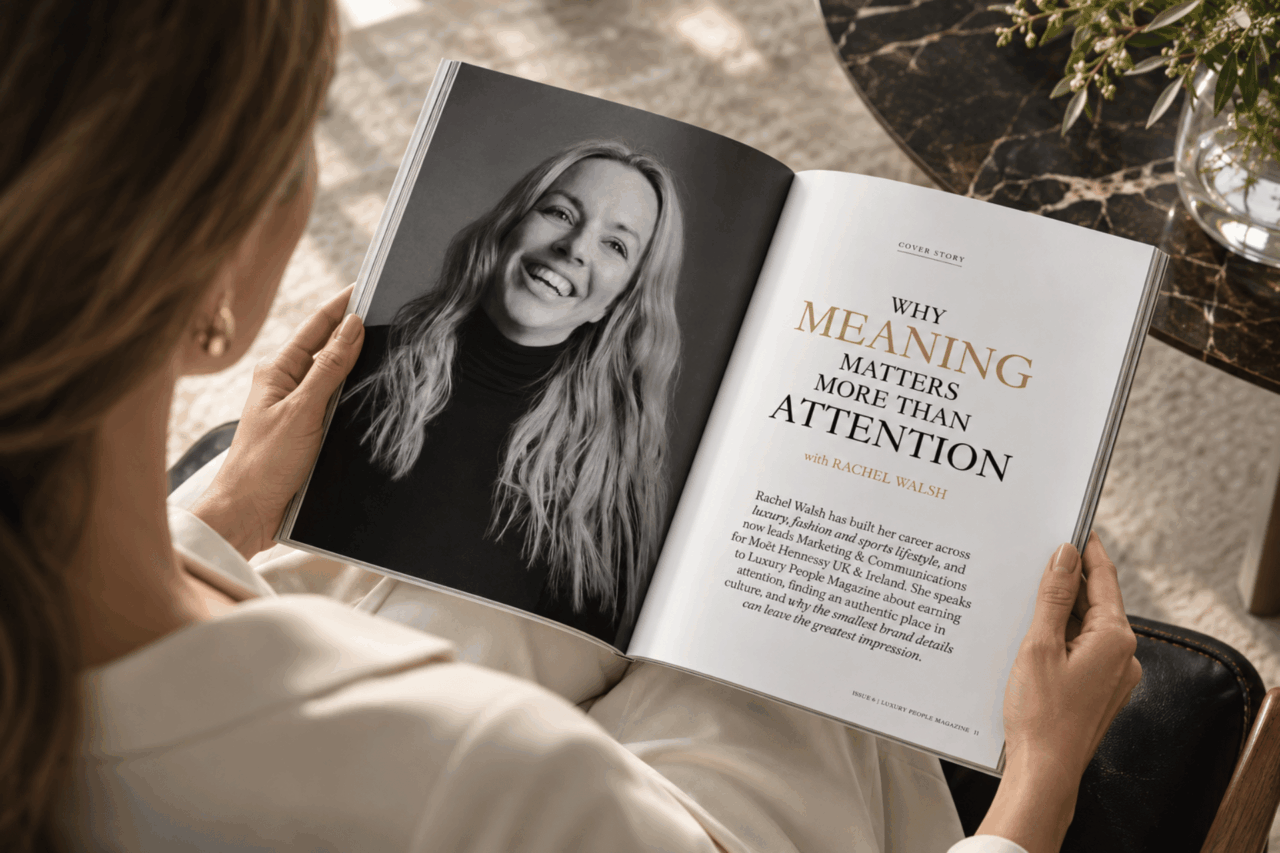
For Rachel Walsh, who leads Marketing & Communications for Moët Hennessy UK & Ireland, one of the biggest challenges facing luxury brands is the distinction between being seen and being remembered.
“Attention is relatively easy to buy. Meaning is much harder to create,” she tells Luxury People Magazine.
In a market where brands can reach audiences through more channels than ever, visibility itself has become abundant. Walsh argues that the stronger measure is resonance. Did someone feel something? Did they remember the experience? Did they want to become part of the brand’s world?
It is an important distinction for luxury marketers. More content, more reach, and more exposure do not automatically create greater desirability. Sometimes a single exceptional interaction can achieve what an extensive campaign cannot.
Lancia Soans, founder of Lancia Designs, approaches the same question from another direction. For her, luxury is moving “beyond status, toward significance.” She sees relationships, shared values, art, craftsmanship, and thoughtful gifting as ways of creating something that carries personal meaning.
In a culture of constant exposure, Soans also sees discretion acquiring greater value. As she puts it, “When everything is visible, nothing is valued.”
Together, the two perspectives suggest an interesting reversal. The next expression of exclusivity may not be about being seen by more people. It may be about creating something that matters more deeply to the right people.
Trust Is Becoming One of Luxury’s Most Important Assets
Trust appears repeatedly throughout Issue 6, particularly in industries where clients are making significant financial or emotional commitments.
Jason Margetts describes luxury real estate as ultimately a “reputation business.” A development may offer exceptional architecture and amenities, but long-term success depends on consistency, operational excellence, service, and delivering on promises repeatedly over time.
He also argues that buyers increasingly evaluate more than the physical asset. Identity, wellness, community, experience, service, and legacy are becoming part of the value proposition, while sustainability is moving from a promotional advantage toward a core expectation.
Achilleas Koukkos, Co-Founder of VILLABEAT, reaches a similar conclusion from luxury travel.
His clients are not simply entrusting the company with the cost of a villa. They are entrusting it with something that cannot be recovered: their time. A family may have only one week together that year. Delivering that experience therefore carries a responsibility far beyond completing a booking.
“A reservation is a transaction. A relationship is something you earn,” Koukkos says.
Kirk Chamberlain applies the same principle to boutique real estate. His agency deliberately focuses on quality over volume, giving each property its own positioning and each client a personalized approach. For Chamberlain, consistency across the team, informed advice, discretion, responsiveness, and local knowledge are all part of the service clients are buying.
Different businesses, different markets, but the lesson is remarkably consistent: reputation cannot be manufactured at the point of sale. It accumulates through what happens before, during, and after it.
Personalization Is Becoming More Precise
Personalization has become one of luxury’s most frequently used words. The leaders featured in Issue 6 make a case for returning substance to it.
For Koukkos, personalization begins with paying attention. Two families can stay in the same villa and require completely different experiences. One may value privacy and minimal interaction. Another may want every day organized.
His definition is simple: “True personalization is not about doing more. It is about understanding better.”
Vanessa Fukunaga, CEO and President of Engel & Völkers Snell Real Estate and Publisher and CEO of Ocean Blue World, similarly defines exceptional service through anticipation, consistency, and listening. The objective is not simply to complete a transaction, but to build a relationship strong enough that clients return and recommend the business to others.
The same principle extends into senior living. Dan Lavender, CEO and President of Moorings Park Communities, argues that sophisticated residences and amenities only go so far if residents do not feel that they belong. His approach combines hospitality with independence, wellness, social connection, purpose, and long-term care.
As future generations enter the category, Lavender expects even greater demand for personalization, flexibility, preventive health, technology, sustainability, and experiences that support a longer, fuller life.
Personalization, then, is moving beyond monograms, preferences stored in a database, or a longer menu of options. At its best, it is the ability to recognize what matters to an individual and respond accordingly.
Technology Should Make Luxury More Human
Artificial intelligence and digital innovation inevitably enter the conversation, but Issue 6 presents a notable degree of agreement about their role.
The question is not whether luxury should use technology. It is how.
At William Raveis, Co-President Ryan Raveis discusses Raveis365+, the company’s proprietary technology platform powered by AI and its virtual assistant, Maia. The purpose is to streamline the buying and selling process and help agents serve clients more effectively.
The principle behind it is captured in one line: “Innovation only matters when it delivers tangible value for clients.”
Koukkos takes a similar position in hospitality. Technology can compare properties, prices, locations, bedrooms, and amenities almost instantly. What it cannot fully determine is why one particular property will feel right for one particular family. VILLABEAT therefore sees technology as a way to give its people more time to listen, understand, and care.
Fukunaga believes AI will make luxury businesses more efficient, personalized, and responsive, but she also expects authentic relationships to become more valuable as technology advances.
Her advice is to embrace innovation without losing identity. “Technology should enhance the human experience, not replace it.”
For luxury businesses, that may become an increasingly important distinction. Efficiency can be automated. Human judgment, empathy, discretion, and the feeling of being genuinely understood are considerably harder to replicate.
Craftsmanship Is Gaining New Context
If technology represents one side of luxury’s future, craftsmanship remains firmly on the other.
But craftsmanship itself is being considered in broader terms.
Perfumer Anu Ruohosto, founder of Scentsophy, combines more than 25 years in the beauty industry with a scientific background in cosmetic chemistry and natural medicine. Her approach brings together technical knowledge, natural materials, instinct, and emotion.
For Ruohosto, exclusivity is not simply about price or scarcity. It begins with why something was created. Her fragrances are composed around emotions rather than demographic profiles, allowing the scent to interact with the wearer’s skin, memory, and individual story.
“Real luxury is something carefully considered,” she says.
Architect Lucila Aguilar similarly connects luxury with intentionality, but through materials, place, culture, and environmental responsibility. Her perspective challenges the idea that sustainability requires compromising beauty or comfort. Instead, natural materials, local craftsmanship, technology, and artisanal knowledge can work together to produce spaces with stronger identities.
The argument is not that luxury should abandon innovation for tradition. It is that innovation becomes more valuable when it has context.
That idea also appears in fashion. Ka Ho’s approach to HEAD Golf places performance and design within a wider lifestyle, with an emphasis on products that solve genuine problems and remain relevant beyond a single season. Looking ahead, he expects consumers to demand greater transparency, smarter materials, longevity, and more sustainable sourcing.
Experience Is Replacing Excess
Perhaps the clearest common thread across Issue 6 is the movement away from excess as the primary expression of luxury.
In real estate, Adrian Kołodziej points to a growing emphasis on privacy, wellbeing, security, service, and lifestyle quality, as buyers increasingly consider how a home supports the way they want to live.
In hospitality, Koukkos describes luxury as relevance: knowing when a guest needs privacy, when they need attention, and when something should happen before they have to ask.
In senior living, Lavender speaks about belonging and flourishing rather than luxury as an end in itself.
In wellness, Malek Semar‘s account of Palace Merano considers personalization, longevity, natural resources, preventive health, and regeneration as interconnected elements of the luxury experience. The property uses its particular location and water resources as part of an experience that cannot simply be replicated elsewhere.
Across these sectors, physical quality remains essential. A luxury hotel still needs exceptional hospitality. A residence still needs outstanding design. A fragrance still requires ingredients and craft. A garment still needs to perform.
But these are increasingly the starting point rather than the conclusion.
The differentiator is what happens around them.
Purpose Is Entering the Value Equation
There is another development running through these conversations: luxury businesses are being asked to consider the value they create beyond the immediate customer.
For Fukunaga, philanthropy is not separate from leadership. She argues that commercial success creates a responsibility to contribute positively to communities and that a brand is ultimately remembered for more than what it sells.
For Lavender, sustainability, wellness, and social responsibility are becoming part of the everyday resident experience rather than standalone initiatives.
For Margetts, environmental responsibility and resilience are increasingly part of what high-net-worth buyers expect from developments.
And for Aguilar, ecological responsibility can actively improve beauty, comfort, and connection to place.
This does not mean luxury is becoming purely altruistic. It suggests something more commercially significant: clients are widening the criteria by which they judge value.
Product, experience, conduct, provenance, impact, and values are becoming harder to separate.
A New Measure of Luxury
Taken individually, the interviews in Issue 6 examine very different corners of the global luxury industry. Taken together, they reveal a striking amount of agreement.
Luxury is becoming more personal without becoming less exceptional. Technology is becoming more important, but so is human contact. Sustainability is gaining relevance, but so are craftsmanship and provenance. Clients have more choice and information, yet trust and expertise carry greater weight.
Most importantly, value is extending beyond the object or transaction.
A home can represent a lifestyle. A fragrance can hold a memory. A hotel stay can contribute to wellbeing. A garment can solve a practical problem while expressing identity. A brand interaction can become a relationship.
Perhaps that is the clearest message from the leaders featured in Luxury People Magazine Issue 6.
The new value of luxury is not simply having more.
It is meaning more to the people you serve.
Explore the full interviews, perspectives, and industry insights in Luxury People Magazine Issue 6.