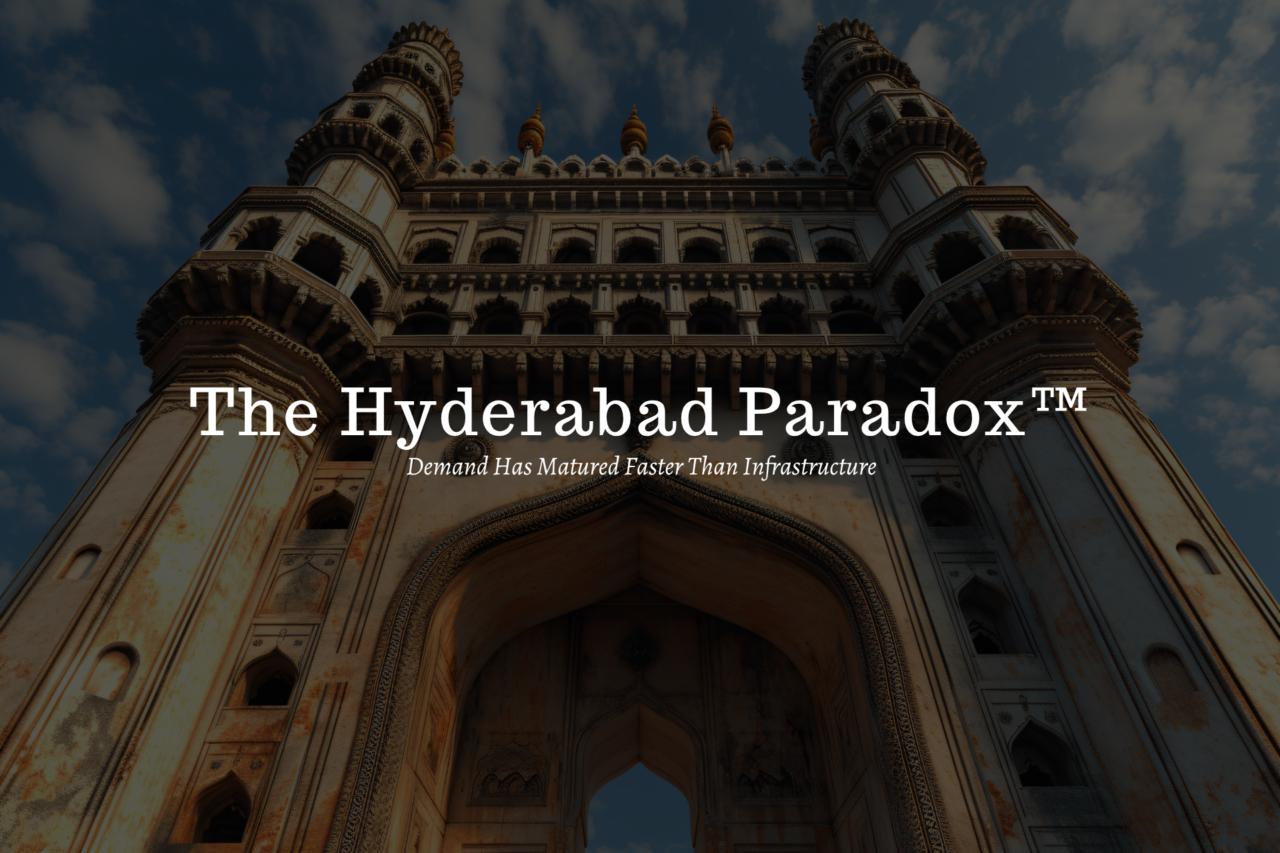
For WLCC members evaluating India’s luxury expansion story, the dominant narrative centres on Mumbai and Delhi as established markets and Bengaluru as the logical next step. The data from LC Intelligence‘s inaugural research series suggests a different sequence.
Hyderabad is the largest ultra-luxury residential market in South India by value. Its HNI household density, overseas travel spend, and ultra-luxury residential transaction volume — at ₹8,562 Cr — place it at 4.0 on a five-point Luxury Readiness demand scale. By that measure, it is not an emerging market. It is a ready one.
Its infrastructure score on the same scale is 2.2. The city has no pure-play luxury mall.
This is the Hyderabad Paradox — and it is the subject of Report I of The Future Geography of Luxury in India, the inaugural series from LC Intelligence, Luxury Connect’s new research vertical dedicated to original, quantified analysis of Indian luxury markets.
The methodology applies a ten-indicator Luxury Readiness Matrix across two dimensions — demand and infrastructure — scored on a five-point ladder from pre-awareness to full lifestyle integration. The result is a city-level measurement, not a projection, giving luxury decision-makers a verified baseline for market entry sequencing.
The series is explicitly designed for comparability. Report I is Hyderabad. Report II is Bengaluru. Report III covers Chennai and Pune. The same framework, the same indicators, the same scale — making each city’s readiness directly comparable to the others and, over time, trackable.
The Hyderabad report also maps what the demand-infrastructure gap produces in economic terms: systematic leakage of luxury spend to competing destinations — Dubai, Singapore, Paris, Bangkok — through infrastructure advantage rather than brand mythology. India’s overseas luxury-correlated travel spend reached US$17 billion in FY2025. The report distinguishes recapturable from structural leakage and identifies the mechanisms through which recapture becomes possible.
The cluster formation analysis — mapping the Anchor–Adjacency–Density–Gravity sequence for Hyderabad’s three candidate nuclei — provides a framework directly applicable to market entry and investment sequencing decisions for any house evaluating the city’s readiness.
The Hyderabad Paradox is available now at LC Intelligence. ₹1,50,000 | USD 1,800.
Abhay Gupta is Founder & Chairman, Luxury Connect, and the author of The Incredible Indian Luxury Bazaar. www.abhaygupta.in | abhay@luxuryconnect.in
Editorial Note: The views and opinions expressed in this article are those of the author and do not necessarily reflect the views of the World Luxury Chamber of Commerce (WLCC). References to organisations, data, and research are provided by the author. To stay up to date with the latest luxury industry insights, research, and thought leadership, sign up for the WLCC newsletter: https://worldluxurychamber.com/category/expert-articles-interviews/