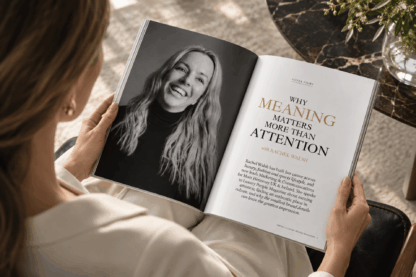
In luxury, the final impression is rarely the product, but the person delivering it. Liz Batsche, founder of Well Hosted and former LVMH executive, shares why presence, not product, is the true driver of trust, loyalty, and revenue.
Luxury People Magazine: You began your career in investment banking before joining LVMH and later founding Well Hosted. What did those early experiences teach you about how trust and credibility are built in high-pressure client environments?
Liz Batsche: Investment banking taught me that credibility is both immediate and precarious. You can be analytically flawless, but if your communication feels uncertain or ungrounded, trust begins to slip, often in ways that are subtle but consequential.
At LVMH, I saw a more refined expression of that same truth. The most effective professionals weren’t simply knowledgeable on the product and category; they were deliberate in how they showed up. They could guide a conversation with quiet authority, create ease in the room, and make clients feel both confident and understood.
What stayed with me is this: in high-pressure environments, expertise is assumed. It’s table stakes. What distinguishes someone is presence. It’s the ability to instill confidence not just through what is said, but through how it is experienced.
Because ultimately, clients don’t just remember the information. They remember how they felt in your presence, and that is what shapes trust.
LPM: Many luxury brands invest heavily in product, design, and marketing, yet the client-facing interaction often determines the final impression. In your view, what are the most common mistakes luxury teams make when engaging with high-value clients?
LB: The most common mistake is over-indexing on the product and underinvesting in the interaction. Teams are trained extensively on what they’re selling, but not always on how they’re showing up. That’s where things begin to break down, and conversations become transactional, rushed, or overly scripted, which is immediately felt by the client. It’s not a feeling they want to repeat!
Another key gap is inconsistency. One exceptional interaction followed by a mediocre one erodes trust quickly, especially with high-value clients who are incredibly attuned to nuance and detail.
And finally, many teams default to serving rather than hosting.
Serving is responsive; it fulfills what is asked. Hosting is anticipatory; it understands what is needed before it’s spoken. It’s not just about meeting expectations, but about interpreting them and elevating them in a way that feels seamless and considered.
In luxury, that distinction is everything. It’s the difference between delivering a product and creating an experience that a client wants to return to.
LPM: Your work focuses on helping professionals turn transactions into long-term relationships. What specific skills or behaviors separate a good luxury service professional from one who consistently drives loyalty and revenue?
LB: The difference comes down to intentionality. Top performers don’t leave interactions to chance. They know how to open a conversation with confidence, read the room in real time, and guide the experience without making it feel controlled.
They’re also highly skilled at listening; not just to respond, but to understand what matters beneath what’s being said. That’s where personalization lives.
And importantly, they know how to continue the relationship. The best professionals don’t think in single moments; they think in sequences. Every interaction builds on the last.
When these behaviors are done well, you see a direct impact, not just in client satisfaction, but in repeat business, referrals, and overall revenue performance.
LPM: Having worked inside a major luxury group and now advising teams across industries, how do you see the role of human connection changing as luxury brands expand digitally and globally?
LB: As brands become more digital and more global, human connection becomes more, not less, important. Technology has made discovery seamless and personalization scalable. But it has also raised expectations. Clients now arrive informed, discerning, and with a very refined sense of what feels authentic versus automated.
The role of the client-facing professional is evolving from information provider to experience creator. The value is no longer in what you know, but in how you translate that into a moment that feels considered and personal.
The brands that will stand out are the ones that use technology to enhance efficiency, while doubling down on the human elements that cannot be replicated: presence, judgment, and emotional intelligence.
LPM: Looking ahead, what shifts do you expect in how luxury brands train and support their client-facing teams, especially as expectations around personalization, service, and trust continue to rise?
LB: We’re moving from product training to performance training. Historically, much of the investment has gone into teaching teams what to say. Going forward, the focus will need to shift to how to say it, and how to adapt in real time.
I also expect a greater emphasis on practice. These are not theoretical skills. Presence, communication, and client engagement are behaviors that need to be trained and refined in live scenarios. This is why I focus on hosting as practice (The Practice of Hosting),
Finally, there will be a stronger link between client experience and business performance. The most forward-thinking organizations are already recognizing that how their teams show up is not a “soft skill”—it’s a commercial lever.
LPM: When clients bring you into their organizations, what are they typically solving for —and what changes after working with you?
LB: Most clients come to me because there’s a gap between the brand experience they’ve designed and the one that’s actually being delivered. They’ll say things like, “Our teams are talented, but the experience isn’t consistent,” or “We’re missing opportunities in key client moments.”
What we uncover is that their teams haven’t been given a clear, shared standard for how to show up in those moments.
After working together, the shift is immediate and visible. Conversations become more confident, more intentional, and more aligned with the brand. Teams know how to lead interactions rather than react to them.
And importantly, leaders begin to see measurable impact: stronger client relationships, increased conversion, and more consistent performance across teams.
LPM: You often talk about “The Practice of Hosting.” What does that mean in a business context, and why does it matter now?
LB: The Practice of Hosting is the idea that every client interaction is an experience you are responsible for shaping.
In a business context, it means moving beyond service into something more intentional. You are not simply responding to needs; you are guiding the moment, setting the tone, and creating an environment where trust can build.
It matters now because expectations have changed. Clients don’t just want efficiency; they want to feel understood, valued, and at ease.
Hosting provides a framework for that. It gives professionals a way to approach every interaction with clarity and purpose; that’s what ultimately differentiates brands in a crowded, highly competitive landscape.
LPM: For leaders reading this, what is one immediate shift they can make to elevate how their teams show up with clients?
LB: Shift the focus from what your team knows to how your team shows up.
Most organizations assume that experience will naturally translate into strong client interactions. Without clear guidance and practice, teams default to habit.
If you define what “great” looks like in a client moment, and give your teams the opportunity to practice it, you’ll see a rapid shift in confidence, consistency, and results.
Because at the end of the day, clients may remember what you said, but they always remember how you made them feel. It’s a principle that deeply informs my work and is reflected in Maya Angelou’s enduring insight: people will forget what you said, but never how you made them feel.
Discover how Well Hosted is redefining client experience training for luxury teams. Connect with Liz Batsche on LinkedIn or visit Well Hosted to explore her approach to building trust-driven performance.
WLCC regularly features conversations and insights from global luxury leaders. Join our community to receive new interviews and perspectives weekly: https://worldluxurychamber.com/wlcc-community/.