By Abhay Gupta – The Indian Luxury Strategist; Founder & Chairman, Luxury Connect & Luxury Connect Business School (LCBS).
A house is not a collection. As the world debates whether Sabyasachi has produced India’s first global luxury maison, the more useful exercise is to measure the structure beneath the runway — and to ask what his project reveals about the future of craft-based luxury itself.
Every generation of luxury produces a moment that reframes the map. This September, that moment wore Indian embroidery. When Sabyasachi Mukherjee returned to the New York runway after seventeen years — admitted, for the first time, to the official CFDA calendar, and opening a multiyear collaboration with The Metropolitan Museum of Art — the industry reached, almost in unison, for the same phrase: India’s first global luxury house.
It is a phrase worth examining rather than repeating. Because a global maison is not conferred by a runway, however celebrated. It is an architecture — a set of structural conditions that either exist or do not — and the honest way to assess Sabyasachi’s achievement is to hold his house up against that architecture, without either the reflexive scepticism or the reflexive triumphalism the subject tends to attract.
The Historical Stakes
To understand why this matters, one must understand what India has been to luxury. For generations, the finest European houses have drawn their craftsmanship from Indian ateliers — the embroidery, the beadwork, the goldsmithing that lends a maison its aura, produced by anonymous Indian hands and sold under European names. India has long been luxury’s most gifted supplier and its least visible one. The question of a global Indian house is, at bottom, the question of whether that century-old arrangement can finally be reversed — whether the maker can become the owner.
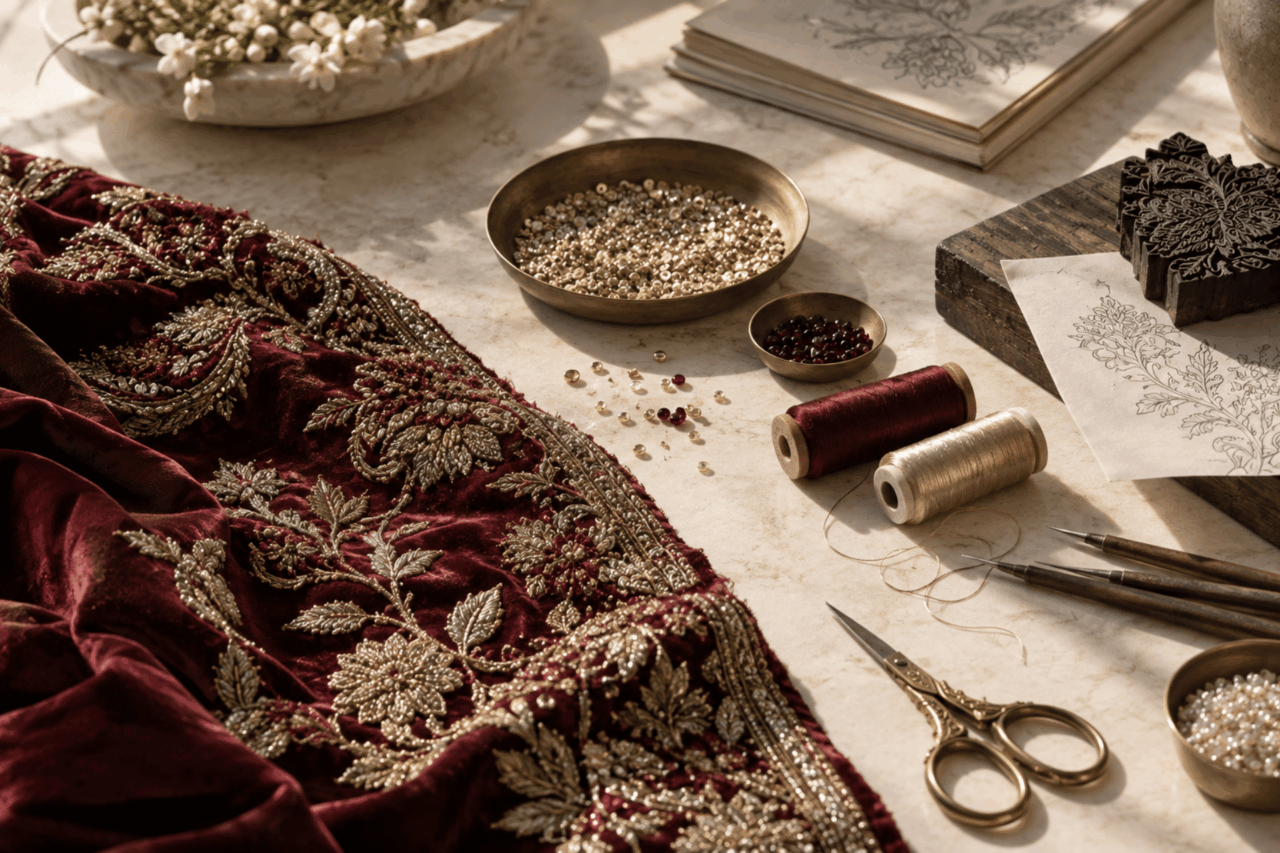
Sabyasachi has done the aesthetic groundwork more completely than anyone before him. He elevated handloom, zardozi and Bengal goldsmithing into genuine ultra-luxury, insisting on a grandeur that erased the old assumption that non-European craft belongs at the lower end of the market. His Royal Bengal Tiger insignia stands as perhaps the first globally recognisable luxury monogram to emerge wholly from Indian identity. The aesthetics are settled. The architecture is the open question.
Three Pillars, Honestly Assessed
A global house rests on three load-bearing structures, and Sabyasachi’s standing differs on each.
The first is a diversified engine. A maison cannot rest on a single hero product; it must scale into high-margin categories — fine jewellery, leather goods, eyewear, beauty. Here Sabyasachi is moving decisively: from bridal couture into fine jewellery, into collaborations spanning Christian Louboutin and Estée Lauder, and, most recently, taking Sabyasachi Fine Jewellery online through Tata CLiQ Luxury to reach affluent buyers well beyond the flagship. The direction is right; the scale is still young.
The second is global reach. His West Village flagship in New York — ten thousand square feet of immersive Indian culture in a Western capital — and his placement in Bergdorf Goodman alongside Cartier and Van Cleef & Arpels represent real physical and prestige parity. Yet the clientele remains anchored in the global South Asian diaspora. The defining test of a universal house — the buyer with no cultural tie who chooses it regardless — is the frontier still ahead.
The third is a controlled ecosystem. The Met partnership supplies museum-grade legitimacy few houses ever attain; the 51% investment by Aditya Birla Fashion & Retail supplies the capital and governance to expand — Indian institutional money backing an Indian creative house precisely as European conglomerates back theirs. What remains unbuilt is the scalable craft infrastructure: the guild systems that let artisanal production grow globally without surrendering its soul. This is the deepest structural challenge, and not Sabyasachi’s alone — it is India’s.
The Lesson Beyond The Label
Assessed fairly, the verdict is neither dismissal nor coronation. Sabyasachi is not yet India’s first global luxury house. He is, more significantly, the first Indian to be constructing the architecture of one in full public view — the aesthetic authority and the global anchor firmly in place, the universal customer and the scalable ecosystem still to be secured.
For the wider industry, his significance is as a proof of method. He demonstrates that craft-based luxury from outside Europe can command prestige, price and cultural authority on the world stage — that the century-old hierarchy of luxury’s countries of origin is not permanent, but contestable. Whether he completes the house will shape not only his own legacy but the confidence of an entire generation of Indian founders deciding whether to build under their own name, or continue to embroider under someone else’s.
The runway drew the world’s attention. The architecture beneath it is where the real story — and India’s real opportunity — now lies.

Abhay Gupta
The Indian Luxury Strategist
Abhay Gupta is recognised as The Indian Luxury Strategist, advising global luxury brands on entering and scaling in India while helping Indian founders build globally competitive luxury businesses. With over two decades of experience leading luxury market expansion, he founded Luxury Connect and Luxury Connect Business School to strengthen luxury capability in India. He is an internationally recognised speaker on luxury strategy and was named among the TOP Luxury Speakers (2026 & 2027) by the World Luxury Chamber of Commerce.
Op-Ed Disclaimer: This op-ed reflects the independent views and analysis of the author, based on publicly available industry research. The opinions expressed are those of the author and do not necessarily reflect the views of the World Luxury Chamber of Commerce (WLCC).
For more expert articles and exclusive interviews, subscribe to the WLCC Newsletter: https://worldluxurychamber.com/wlcc-community/