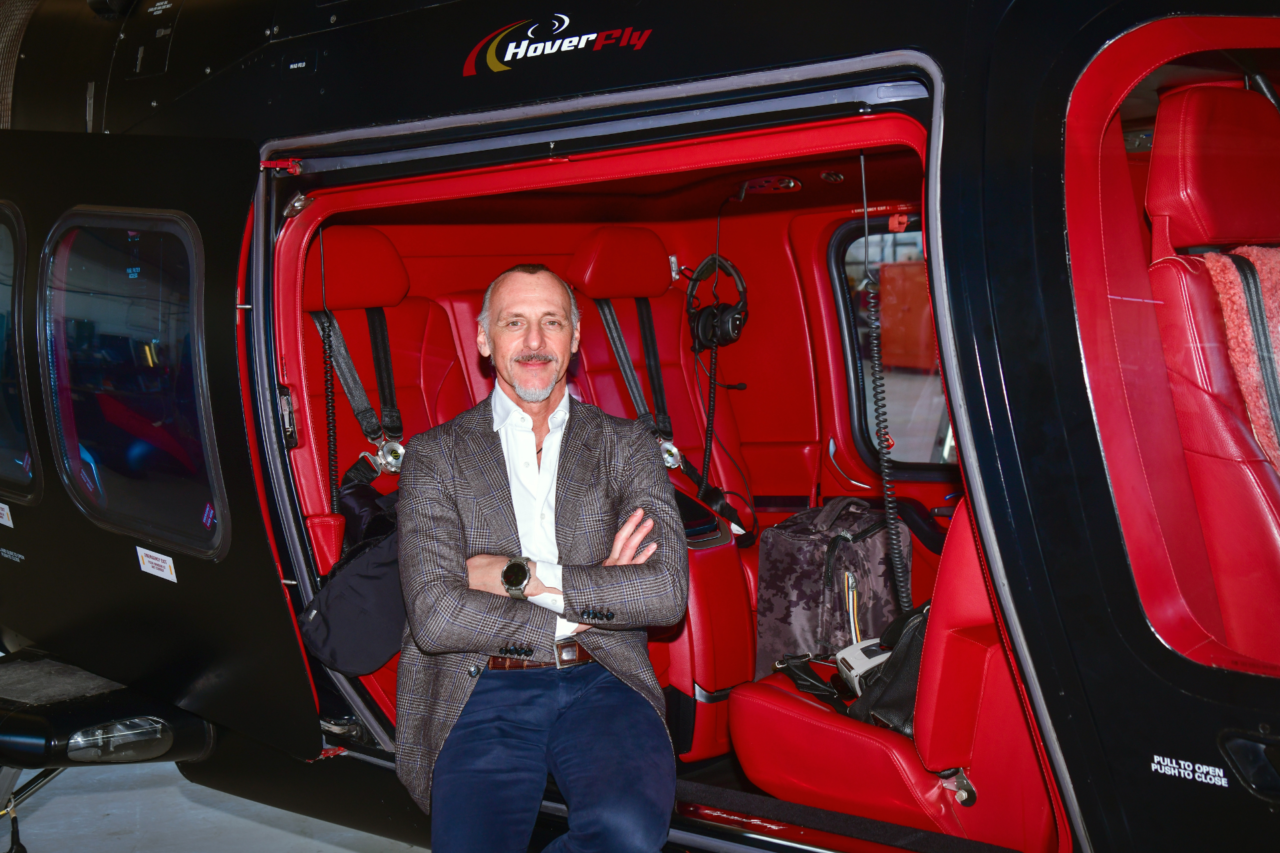
In this exclusive interview, World Luxury Chamber of Commerce speaks with Saturnino De Cecco, CEO of Hoverfly, following the company’s recognition as the 2026 Best Luxury Helicopter Service in Italy. Founded in 2009, Hoverfly specializes in tailor-made private helicopter transfers, serving leisure and business travelers across Italy and neighboring countries. Its operational model brings together dedicated sales and operations teams, technical expertise, skilled flight crews, and a varied fleet that includes VIP-configured aircraft.
Hoverfly’s scope extends well beyond passenger transport. The company operates its own Flight Academy and MRO activities, holds HOFO certification for offshore operations, and works closely with Leonardo. Recent developments include the addition of a next-generation Airbus H130 and the opening of a new operational hangar in Casoria near Naples-Capodichino Airport, further expanding its infrastructure and capabilities. In our conversation with Mr. De Cecco, we explore the thinking behind Hoverfly’s growth, its approach to personalized aviation, and what lies ahead for the company.
WLCC: Congratulations, Saturnino, on Hoverfly’s second LLA victory! Hoverfly was founded in 2009 and has since developed into a multifaceted aviation company. Looking back, what were the defining decisions that transformed the business into the Hoverfly we see today?
Saturnino De Cecco: It all began in 2009, driven by a personal passion for flying. I was already a licensed private airplane and helicopter pilot, and I had identified a gap in the Italian market: the lack of a truly executive-level service offering the consistency in quality and customer care that had long been the standard in the private jet industry.
In helicopter transportation, aircraft primarily designed for aerial work were often also used to carry passengers. The interiors, the welcome experience and the crews’ presentation did not always reflect the standards of a dedicated executive service. I was sure that the market was ready for something different.
I therefore decided to acquire three helicopters: two AS355Ns, one of which remains part of our fleet to this day, and an eight-seat Dauphin N2. My goal was to build an organization designed from the ground up specifically for executive transportation.
Being a private pilot and entering the world of commercial air transport are, however, two very different experiences. Knowing how to fly is only the starting point. You need to build an organization around certifications, procedures, professional crews, qualified technicians, maintenance, training and continuous oversight. It is an industry governed by increasingly complex and stringent regulations. I quickly realized that the quality perceived by the passengers depends, above all, on the strength of the organization behind the service.
The principle that has guided my decisions is simple. My family instilled in me an entrepreneurial mindset rooted in quality and the pursuit of excellence in every aspect of our work. These are the values I have sought to bring to Hoverfly, through our people, our investments and our unwavering attention to detail in everything we do.
WLCC: Hoverfly emphasizes tailor-made travel rather than a standardized charter experience. When a client approaches you with a particular itinerary or request, how do your teams turn that initial idea into a highly personalized flight experience?
SDC: Our commercial and operational teams manage thousands of requests, captured in our CRM and refined through ongoing dialogue with clients. The defining characteristic of this work is its inherent variability: hardly any two requests are ever the same.
The helicopter is chosen precisely for its versatility. It often completes a journey that begins on a private jet or a scheduled flight, taking passengers from the airport on to an island, a hard-to-reach destination or, where operational conditions allow, directly to a yacht. Its greatest value lies in its ability to bring passengers as close as possible to their destination. Yet this same flexibility makes planning particularly demanding. I often say that a helicopter adds time, whether the journey is for business or leisure. And that is precisely what it does: it gives passengers back time.
Quite rightly, the client sees only the tip of the iceberg: they make a request and, ultimately, board the aircraft. Behind that seemingly simple experience, however, there may be dozens of exchanges covering the itinerary, passenger numbers, luggage, timings, landing-site characteristics, connections with other flights and potential alternatives. Every detail matters, and every change must be carefully assessed from an operational perspective to ensure that the flight remains feasible, safe and aligned with the client’s needs.
Our strength lies in our ability to respond quickly and flexibly, while always respecting the aircraft’s operational limitations, prevailing flight conditions and applicable regulations. Sometimes, this means proposing an alternative to the client’s original plan and clearly explaining the reasons behind it, in order to find the best possible solution without compromising safety or operational feasibility.
I believe this work remains undervalued, including in economic terms. Too often, the cost of a helicopter service is assessed primarily in relation to the minutes spent in the air, overlooking the substantial work that takes place before take-off. A significant part of the service is, in fact, delivered long before the aircraft leaves the ground.
I remember a pilot who, years ago, joked that transporting a tree trunk suspended beneath a helicopter would be easier than organizing some of the journeys we arranged for our passengers. Today, he works in passenger transport himself, which always makes me smile. I like to think that Hoverfly helped open up a new path and raise expectations for this type of service in Italy. And I believe that is exactly what we did. Hoverfly is specifically structured around this kind of operation — something that remains relatively rare in Italy.
WLCC: In private aviation, luxury is often associated with the aircraft itself, but the experience begins long before takeoff. What details do you believe make the greatest difference in creating a truly premium helicopter journey for a client?
SDC: I believe the essence of luxury lies in the respect for the client’s time and the trust we build through efficiency and professionalism. As a pilot, I have always regarded flying as a serious responsibility; that principle is deeply rooted in my professional culture. Anyone choosing a service like ours wants to know they are in capable hands, working with people who understand not just the flight itself, but the entire journey and every detail that makes it work seamlessly.
Speed and precision in our responses are essential, as are discretion, aircraft care, crew presentation and seamless coordination with everyone involved in the client’s journey, both before and after the flight. Knowing in advance how much luggage the client will be travelling with, how they will reach the departure point and who will be meeting them on arrival allows us to anticipate needs, prevent potential issues and ensure that every part of the journey runs as smoothly as possible.
Then there is the ability to manage the unexpected. In aviation, weather conditions can change, connecting flights can be delayed or rescheduled and passenger requirements can evolve. True quality is also reflected in how these changes are anticipated, communicated and managed.
Being up to the task also means knowing when a request needs to be adapted and explaining clearly why. The operator’s professionalism and the crew’s independent judgement are an integral part of the value the client is paying for. Our goal is to make every journey feel effortless, even though delivering that experience requires a highly complex operation behind the scenes.
WLCC: Hoverfly has been an early adopter of aircraft and configurations such as twin-engine helicopters on short routes, the AW169 in VIP configuration, and the AW109 Trekker. How do you decide when a new aircraft or technology is the right investment for the company and its clients?
SDC: There is no mathematical formula. Personally, I have always tried to grasp, through feedback and requests from our clients around the world, how their expectations were evolving and how we could create a better service.
When I acquired SAM in Salerno, the business was primarily focused on passenger transport across the Gulf of Naples using single-engine helicopters. Having spent a great deal of time in Capri myself, I had seen how the island’s hospitality offering and international clientele were growing year after year. It became clear to me that transfers to the island needed to evolve in line with that offering.
One of our first decisions was therefore to dedicate an AW109S to the Naples–Capri route, operated with two pilots. The response from clients was immediate: they noticed the change and appreciated the enhanced level of service, which remains one of our most requested offerings today.
Every helicopter, however, must be evaluated in relation to its mission. A model that is well suited to one route may be less suitable for another. Performance, passenger capacity, luggage allowance, comfort, the specific geographical features of each destination and operating costs all need to be carefully balanced against the price the market is prepared to pay.
Today, the continued rise in aircraft acquisition and component costs makes these decisions even more challenging. That is why I approach innovation with interest, but also with a great deal of pragmatism. Any new technology must deliver tangible benefits for both the operator and the client.
For manufacturers, developing a completely new aircraft is an enormous challenge as well. The evolution of a proven platform can often be an equally valid solution. My role is to choose what our increasingly knowledgeable and demanding clients actually need, trying to anticipate their requirements while keeping firmly in mind the operational complexities involved, including but not limited to – the resulting flight-crew training, maintenance costs and regulatory requirements.
WLCC: In 2026, Hoverfly announced the addition of a next-generation Airbus H130, with factors such as noise reduction, onboard technology, safety, and the potential use of Sustainable Aviation Fuel forming part of the investment strategy. How do you see sustainability influencing the future of executive helicopter travel?
SDC: The new Airbus H130 perfectly illustrates the concept I have just described: investing in the technical evolution of an established model that we know well and that our clients have greatly appreciated. It will replace an aircraft of the same type that has served us very well, continuing the renewal of our fleet.
Sustainability is a responsibility we all share, including operators like us. Personally, I am committed to moving in this direction, but I believe it is important to speak openly about the practical challenges involved.
Take sustainable aviation fuel (SAF), for example. The new H130 is designed to operate on SAF, but its actual use depends on availability at the locations where we operate and on its cost. For the transition to be viable, the entire supply chain needs to support it. If investment and operating costs increase, we also need to consider the impact on the final price of the service and how much the market will be willing to bear. The risk is that the entire additional cost is passed on to the client, while delivering only limited environmental benefits.
In the meantime, there are practical steps we can take within our own operations: selecting the right aircraft for each mission, planning more efficiently and, wherever possible, optimizing positioning flights. These choices can make a meaningful difference, too.
I have followed the development of eVTOLs (electric vertical take-off and landing aircraft) from the outset. It is an interesting field, but expectations regarding the pace of deployment and certification have been very ambitious. Personally, I also draw a clear distinction between piloted aircraft and autonomous flight, as they raise different operational challenges and different issues when it comes to passenger confidence.
As an operator, I want to understand the range these aircraft can actually achieve under real operating conditions, including when carrying luggage; how they perform in different weather conditions; how their batteries and propulsion systems withstand intensive use, particularly at the exceptionally high temperatures we have experienced this year; how long recharging takes; and what dedicated infrastructure is required. Four available seats do not automatically translate into four paying passengers on every route. When assessing an aircraft’s actual carrying capacity, payload is a key consideration.
Certification will be a crucial milestone, as will the ability to manage emergencies, as it should be. I have always been open to new technologies, but I will evaluate them once they become capable of delivering a service that is safe, reliable and economically sustainable.
WLCC: Unlike businesses that operate purely as charter brokers, Hoverfly combines flight operations with maintenance, continuing airworthiness management, technical expertise, and its own Flight Academy. How does having these capabilities within the wider organization strengthen the experience and confidence you can offer passengers?
SDC: We have built an organization that brings together operational, technical, training and commercial expertise. This allows our Sales Team to interact directly with those responsible for assessing, preparing and delivering it. We have an in-depth knowledge of our helicopters, oversee their maintenance and invest in our people’s training. Passengers benefit from all this work through the quality of the service we provide and the precision of our responses.
We work with international brokers and operators, who are valued partners and entrust us with the helicopter leg of more complex journeys. At the same time, we are seeing a growing number of clients approach us directly.
It was precisely these requests that drove a natural evolution of our business: clients booking a helicopter transfer would often ask us to arrange their private jet travel as well. In response, we have significantly expanded our private jet brokerage activity in recent years, dedicating internal resources with specialized expertise and established relationships with a network of qualified operators.
For helicopter operations, we rely on our own operational structure. For private jets, we select the most suitable operators and take care of coordinating the overall journey. This complementary activity strengthens the collaboration between industry professionals that underpins many of the services we offer.
Today, we can therefore offer a comprehensive, end-to-end service, coordinating private jet flights, helicopter transfers and ground transportation through a single point of contact who understands the client’s needs and ensures a seamless journey from beginning to end.
WLCC: The new Casoria facility near Naples-Capodichino Airport adds approximately 900 square meters of covered hangar space, offices, a certified helipad, and dedicated Jet A1 refueling facilities. What opportunities does this new base create for Hoverfly, particularly in serving Southern Italy and destinations such as Capri and the Amalfi Coast?
SDC: We have a long-standing presence in the Salerno area, close to an airport that is gradually expanding its commercial operations. At the same time, Naples-Capodichino remains a key gateway for travelers heading to Capri, the Amalfi Coast and other destinations in the region. Strengthening our presence in Naples was therefore a natural step.
Our base in Casoria brings our helicopters, teams and infrastructure closer to where demand is concentrated. During the summer, securing slots at Capodichino can be challenging, making it more difficult to coordinate connections. Being based nearby gives us greater flexibility in how we operate and, when needed, allows us to arrange ground transfers to the airport.
The hangar also allows us to base helicopters directly in the Naples area, making it easier to deploy our fleet efficiently and maximize aircraft utilization. This also brings benefits in terms of maintenance and overall operational efficiency.
Our ambitions for Casoria extend beyond passenger transport. Once the necessary approvals are in place, we plan to develop maintenance activities at the site, while the offices and available facilities also create opportunities for training. This investment supports the development of several areas of our business, giving us a strong platform for future growth.
WLCC: After more than 15 years of developing Hoverfly, what is your vision for its next chapter? Are there particular services, markets, aircraft, or areas of aviation that you are especially interested in developing over the coming years?
SDC: My ambition is to keep growing the business in a sustainable way, strengthening the quality of our service while continuing to develop the expertise that underpins it.
Executive transportation remains at the heart of what we do. Our established presence in Southern Italy, together with our base at Milan-Bresso, gives us a stronger footprint across the country and brings us closer to clients in the North, whether they are travelling for business or leisure. We expect to open additional bases soon, further expanding our reach and allowing us to respond to demand with greater flexibility and efficiency.
We will continue investing in the fleet and in the integration of helicopters and private jets, an area in which client demand has already led us to develop a more comprehensive offering.
I see considerable potential to grow our maintenance and training activities as well. Casoria gives us the space to develop these areas further, building expertise that can support not only Hoverfly but other operators too. We are also exploring opportunities in HEMS (Helicopter Emergency Medical Service), an area in which we believe we have the right people and professional capabilities to take the next step.
Through our ATO, and in collaboration with the universities we work with, we can also play a role in training the next generation of pilots and developing young people who will go on to become qualified, certified technicians. I would like to see the experience and expertise we have acquired over the years put to wider use, contributing wherever possible to services that bring tangible benefits to the local community.
The principle that has guided me from the beginning remains unchanged: to focus on activities where we can deliver genuine quality and maintain those standards over time.
Receiving a second recognition from Luxury Lifestyle Awards is a great source of pride and satisfaction for our entire team. I would like to thank each member for their daily dedication, commitment, and professionalism. They are the true soul of Hoverfly, and this recognition is a meaningful incentive to keep on growing, evolving and striving for excellence.
Thank you, Mr. De Cecco, for sharing your insights into Hoverfly’s journey, the philosophy behind its private aviation services, and your vision for the company’s future.
To discover Hoverfly’s private helicopter services, fleet, destinations, and aviation capabilities, visit the company’s official website: www.hoverfly.it.
WLCC regularly features conversations and insights from global luxury leaders. Join our community to receive new perspectives weekly: https://worldluxurychamber.com/wlcc-community/.