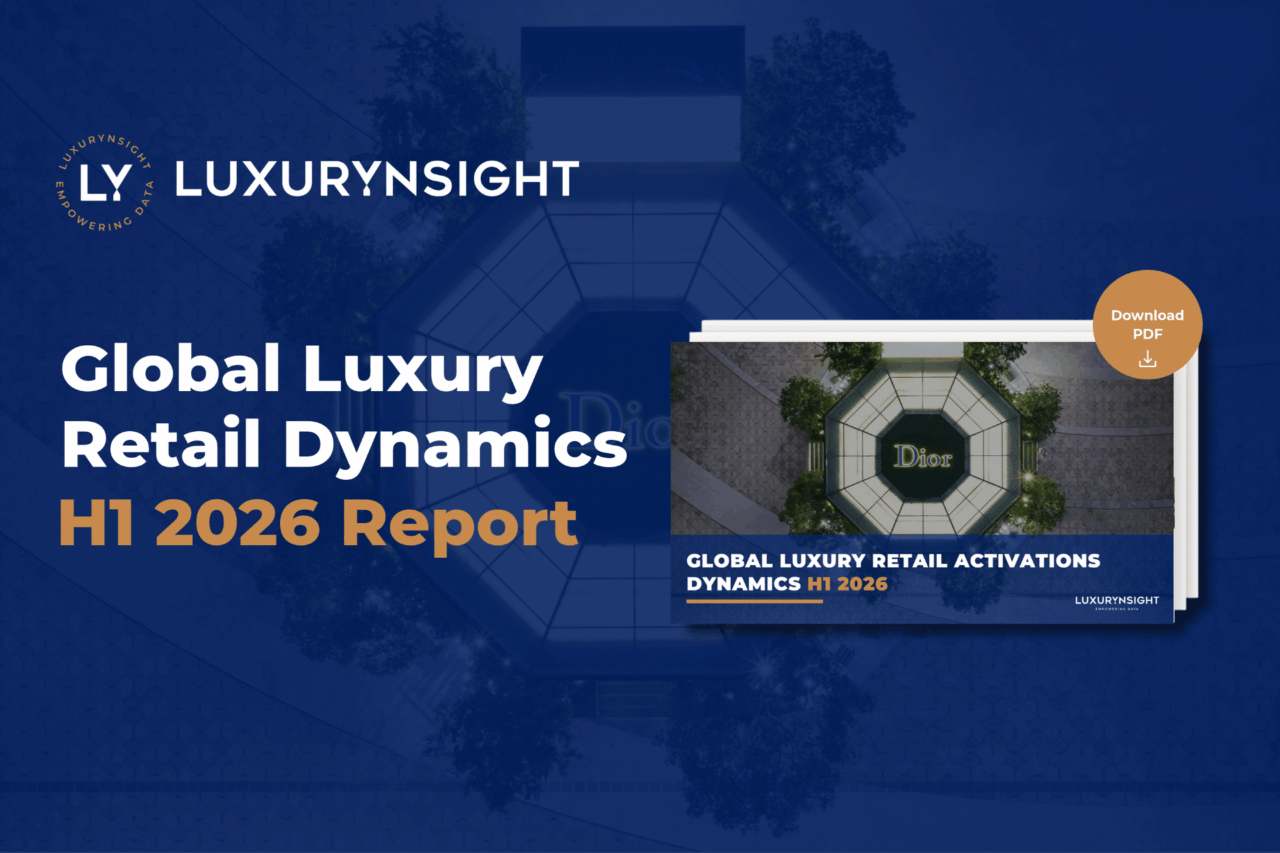
Luxury brands are reducing retail activity without abandoning physical stores. Luxurynsight’s Global Luxury Retail Activations Dynamics H1 2026 tracks 1,150 activations, down 12% from a year earlier. Yet its store category edged upward, while pop-ups contracted sharply. The contrast suggests a more selective approach to where brands commit, and how long they intend to stay.
Across the 60 brands covered, recorded store activity reached 600, compared with 591 in H1 2025. Pop-ups fell 22% to 495. Stores consequently accounted for 52% of activations, up from 45%. The definition matters: Luxurynsight includes reopenings, entries into multibrand retailers, new-market entries and after-sales services within its store category. These figures measure tracked activity rather than net growth in the global store network.
Geography explains much of the divergence. Mainland China recorded a 27% decline in activations, with stores and pop-ups both retreating. Outside mainland China, store openings rose 15%. Japan, Europe and North America recorded growth in overall activations, demonstrating how a global contraction can conceal opportunities elsewhere. Even within regions, individual locations told different stories. Vancouver rose to first place in the report’s North American city ranking, with 14 of its 15 activations concentrated at Oakridge Park. A single development can move a city sharply up the table.
Product categories were equally uneven. Watches and jewelry recorded 29% growth in activations, the only sector to expand. Its store activity increased from 202 to 245, while beauty activations fell 29%, largely through fewer pop-ups. Fashion and leather goods declined more modestly, by 5%. Together, these results challenge any assumption that luxury brands are responding to market pressures in the same way.
The report’s examples also show how brands are giving shoppers more reasons to enter. In China, garden installations and beauty experiences accompany a smaller activation count. At airports, concepts include personalized fragrance services and consultation spaces. Aesop’s Changi store, for example, uses locally sourced bamboo, a central consultation sink and a fragrance library to connect the store to its setting. Such projects illustrate the attention being paid to the visit itself.
For luxury businesses, the practical implication is that activity counts need context. A rising share of stores can reflect fewer pop-ups; a city’s apparent momentum can depend on one opening. The commercial question is what each location enables: access to a particular clientele, time for personal service, or a stronger reason to visit. Luxurynsight’s findings make that choice more pressing as brands concentrate their physical presence.
Want to receive updates about new reports, expert insights, & more? Sign up to our community below:
Sources
Luxurynsight, Global Luxury Retail Activations Dynamics H1 2026, powered by LY Retail. Based on Luxurynsight Brandwatch data comparing H1 2025 with H1 2026.