A new strategy paper argues that the difference between a code and an Icon explains why India supplies global luxury and captures so little of its value, and it sets out the institution designed to change that.
By Abhay Gupta – The Indian Luxury Strategist; Founder & Chairman, Luxury Connect & Luxury Connect Business School (LCBS).
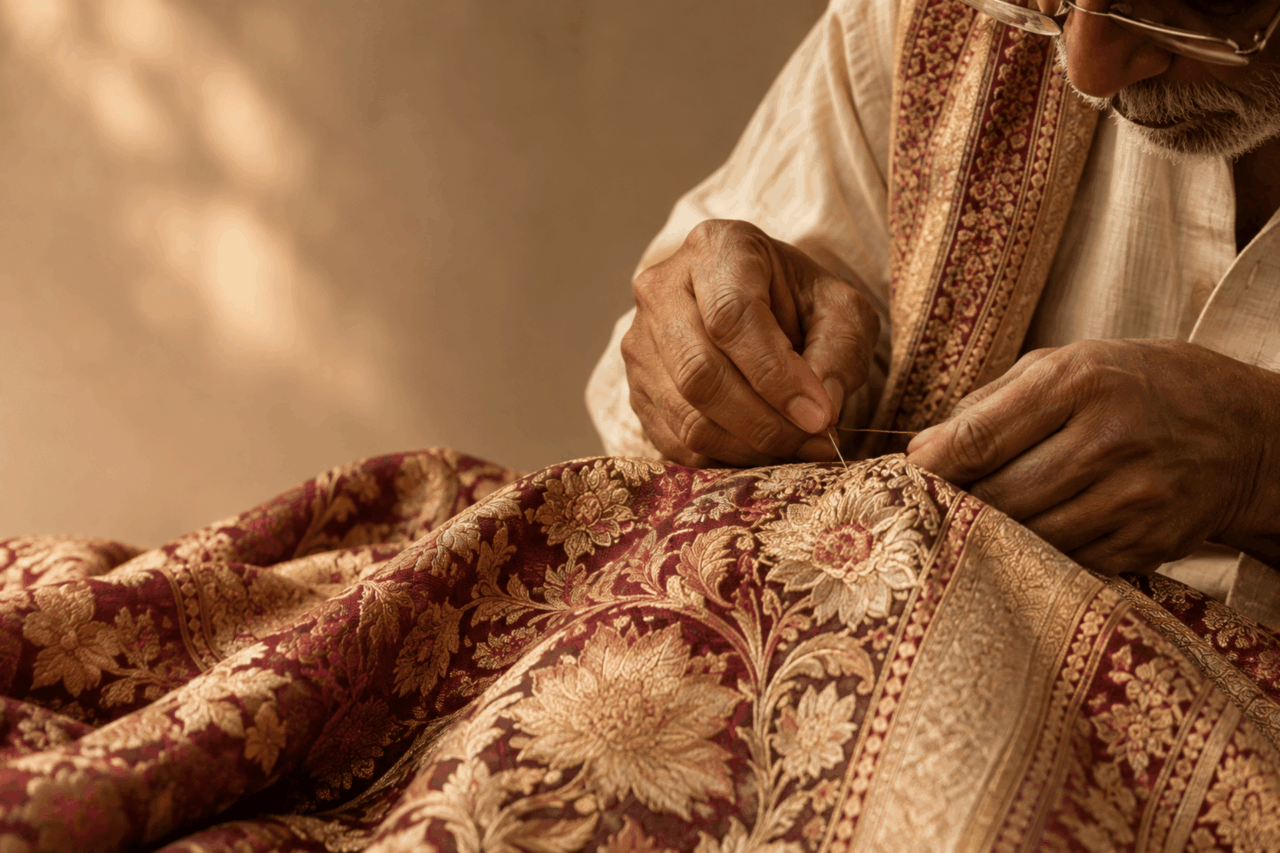
When a European house needs embroidery of a caliber that Europe can no longer produce at scale, it very often comes to India. The hands are Indian and the hours are Indian. The name on the finished piece, and the price it commands, are not.
This is one of the quiet mechanisms beneath global luxury. India supplies the input, and the house elsewhere owns the brand. Building the Shilp-Griha, the fourth paper in the Luxury Connect Strategy Series, sets out to change that, not by complaint but by design.
A gap in institutions, not in craft
One comparison frames the whole argument. India’s handicraft exports were about USD 3.7 billion in 2022–23. Swiss watch exports alone were about CHF 26.7 billion (about USD 29.7 billion) in 2023. A single European category out-earns the handmade exports of a civilization of seven million artisans by close to eight to one.
That gap does not reflect any shortage of skill. Kashmir’s fine needlework, the brocades of Varanasi, the double-ikat Patola of Gujarat and the silks of Kanchipuram are among the most demanding crafts practiced anywhere. What India lacks is the institution that turns such mastery into a house the world pays a premium for.
Code versus Icon
The paper draws a distinction that explains much of the gap. It separates a code from an Icon.
A code is an applied mark: a logo, a monogram, a pattern on a canvas. Codes matter, but anyone can draw one.
An Icon is something else. It is a single identifier product so complete that, with every logo removed, it is still unmistakably the house’s own. Every great house has one, whether a jacket, a dress or a bag that the world recognizes across a room. India’s own heritage offers equivalents: a double-ikat sari that takes a year to weave, or a shawl fine enough to pass through a ring.
The test is exact. Strip the logo, and if the object is still unmistakably yours, you have built an Icon. If it is not, you have built a label.
Why the Icon matters more for a house of craft
For a craft house, the Icon is necessarily a made object, made by hands that took a lifetime to train. That makes it the precise point at which the artisan’s skill stops being a disposable input and becomes the house’s permanent, ownable equity.
This is where the argument becomes uncomfortable for India. The country supplies the craft behind many of the world’s Icons and owns almost none of its own. A Banarasi sari is a category, not yet one house’s Icon. India has codes in abundance and craft without equal. What it has rarely built is an Indian object that would survive the removal of its own logo and still command a house’s premium.
The institution designed to make one
The paper’s answer is the Shilp-Griha, an indigenous house of craft first set out in the Shilp-Griha Manifesto, the previous paper in the series. This paper makes the idea operational, and three of its choices bear directly on the Icon.
The first is that the master artisan, the Shilpi, becomes a compensated stakeholder rather than a piece-rate supplier. The knowledge in those hands is the house’s intellectual property. A house that treats its makers as vendors is renting its own intellectual property, and it can be outbid for it at any time.
The second is that the house speaks on its own calendar rather than on the fashion season’s. An Icon is built over decades, not seasons.
The third is that the point of sale shows the making rather than hiding it. For Indian craft, the provenance is the premium, and an Icon whose making is invisible has thrown away half its meaning.
The paper also sets out the operator who runs such a house, the five stages in which it is built, and the governance that lets it survive its founder.
What this means beyond India
None of this is an argument against the world’s great houses, many of which have honored long partnerships with Indian ateliers. It is an argument that India’s craft deserves institutions of its own, built to the same standard of discipline.
For the global industry, the shift is worth watching closely. As Indian houses learn to own their Icons, the most interesting relationships with them will be partnerships between equals rather than procurement contracts.
India has supplied the world’s Icons for long enough. The next step is to own some.
Building the Shilp-Griha: The Operating Model for India’s Houses of Craft is available free at luxuryconnect.in/lc-intelligence/

Abhay Gupta | WLCC Voice
The Indian Luxury Strategist
Abhay Gupta is recognised as The Indian Luxury Strategist, advising global luxury brands on entering and scaling in India while helping Indian founders build globally competitive luxury businesses. With over two decades of experience leading luxury market expansion, he founded Luxury Connect and Luxury Connect Business School to strengthen luxury capability in India. He is an internationally recognised speaker on luxury strategy and was named among the TOP Luxury Speakers (2026 & 2027) by the World Luxury Chamber of Commerce.
Op-Ed Disclaimer: The views and opinions expressed in this article are those of the author and do not necessarily reflect the views, positions or policies of the World Luxury Chamber of Commerce (WLCC).
Want to receive updates about new reports, expert insights, & more? Sign up to our community below: