By Sherrie Wilkolaski, Editor-in-Chief, Content Strategist, Publishing Architect™
Somewhere between a vacation-rental founder in Texas, a textile designer working out of a Cambodian rainforest, a resort executive in Antigua, and a furniture designer building beds in Sweden, a pattern started to surface, one I did not go looking for. Interviewing hoteliers, founders, designers, and conservationists for Luxe Beat Magazine, one conversation at a time, is simply the job. But in industries that otherwise share almost nothing, none of these leaders talked about luxury as more. Nearly all of them talked about it as less fewer choices, less noise, less competing for attention, and arrived at with far more intention than that simplicity suggests.
The rejection of scale for its own sake.
David Bucci of HomeExchange Collection described this most plainly. “Curation is at the heart of HomeExchange Collection,” he told me. “These aren’t simply luxury homes because of a price point or number of bedrooms; they’re homes with character, history and a distinctive sense of place.” What makes a property worth including, in his framing, was never really about size. It was about whether the home, and the person behind it, had something genuine to offer.
Kari Tarnowski, Chief Commercial Officer of Elite Island Resorts, made the same argument from the hospitality side, rooted in a very specific number. Hammock Cove Antigua holds just 102 private villas, deliberately. “Operationally, when you have only 102 private villas, you can create experiences that feel highly personalized,” she said. “The team knows the guests, can anticipate preferences, and can adapt in real time in a way that is much harder to achieve at a larger resort.” Smaller, in her telling, was not a constraint the resort worked around. It was the entire point.
Restraint as the actual creative discipline.
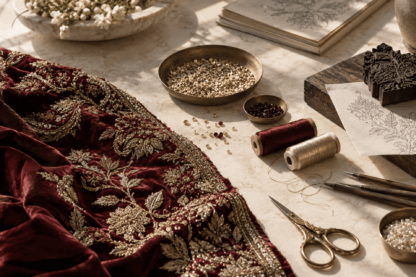
Bill Bensley, the designer behind Wild, his textile collaboration with Jim Thompson inspired by Cambodia’s Cardamom Mountains, described something that sounds at first like the opposite of restraint: bold color, maximalist pattern, “chaotic, noisy, full of life.” But listen closer, and the discipline is in what he refused to do. “Every pattern, every odd detail comes from something that actually exists out there,” he said. Nothing invented for its own sake, nothing added simply to fill space. “People assume conservation has to look serious, worthy, a bit guilt-ridden,” he told me. “I don’t buy that. If you want people to care about a place, you don’t scold them, you make them fall in love with it.” The restraint was never in the palette. It was in refusing to let the message overpower the feeling.
Ferris Rafauli, the designer behind Hästens’ latest bedroom collaboration, described a nearly opposite-sounding but philosophically identical idea, from a much quieter register entirely. “The bed is not just another element in the room,” he said. “It’s the reason the room exists.” Every other design decision, lighting, materials, acoustics, exists to serve that one object, not to compete with it. “You’re not designing for attention,” he told me. “You’re designing for absorption.”
And underneath both: luxury as the thing you don’t notice, not the thing that announces itself.
Rafauli’s language on this point was the most direct of anyone I’ve spoken with this year. A bed, he said, “holds you.” A sleep instrument, properly designed, “restores you.” The difference between the two is not visible in a photograph. It only shows up in how a person actually feels, hours after the design has done its work and stopped asking to be noticed.
Tarnowski described the same shift in what hospitality guests actually remember. “Luxury travelers still care deeply about comfort, design, service, and food, but those things are now the baseline,” she said. “What they remember is the feeling.” Not the amenity list. Not even, really, the caviar. “It is not about adding activities just to fill a calendar,” she said. “It is about creating experiences that feel intentional, connected to the destination, and worthy of the setting.”
What this actually tells us.
Four leaders, four industries, a vacation-rental platform, a Caribbean resort, a textile designer working from a rainforest, and a Swedish bed maker, none of them coordinating with each other, none of them aware the others had said anything close to the same thing. And yet the shape of the answer barely changed: decide more precisely, refuse the unnecessary, and then get out of the way of the feeling you were actually trying to create.
Bensley put language to what may be the clearest version of this entire idea, and it is worth letting him close it. “It’s about meaning, quality, and a sense that someone has really paid attention,” he said. “Luxury is freedom from compromise, but also generosity: giving someone an experience they didn’t expect but now can’t forget.” Not more. Not louder. Simply, unmistakably, attended to.

Sherrie Wilkolaski
Editor-in-Chief | Content Strategist | Publishing Architect™
Sherrie Wilkolaski is the Publisher and Editor-in-Chief of Luxe Beat Magazine, an award-winning luxury travel and lifestyle publication, and CEO of Luxe Beat Media. She is a luxury lifestyle journalist, bestselling author, and Publishing Architect™. Her column, Cookies & Cocktails, is one of Luxe Beat’s most popular. She is a former International Food, Wine and Travel Writers Association board member and treasurer, and a member of NATJA, ITWA, WTN, BPW, and SPJ.
Editorial Note: The views, opinions, and analysis expressed in this article are those of the author and do not necessarily represent the views or positions of the World Luxury Chamber of Commerce (WLCC).
For more expert articles and exclusive interviews, subscribe to the WLCC Newsletter: https://worldluxurychamber.com/wlcc-community/