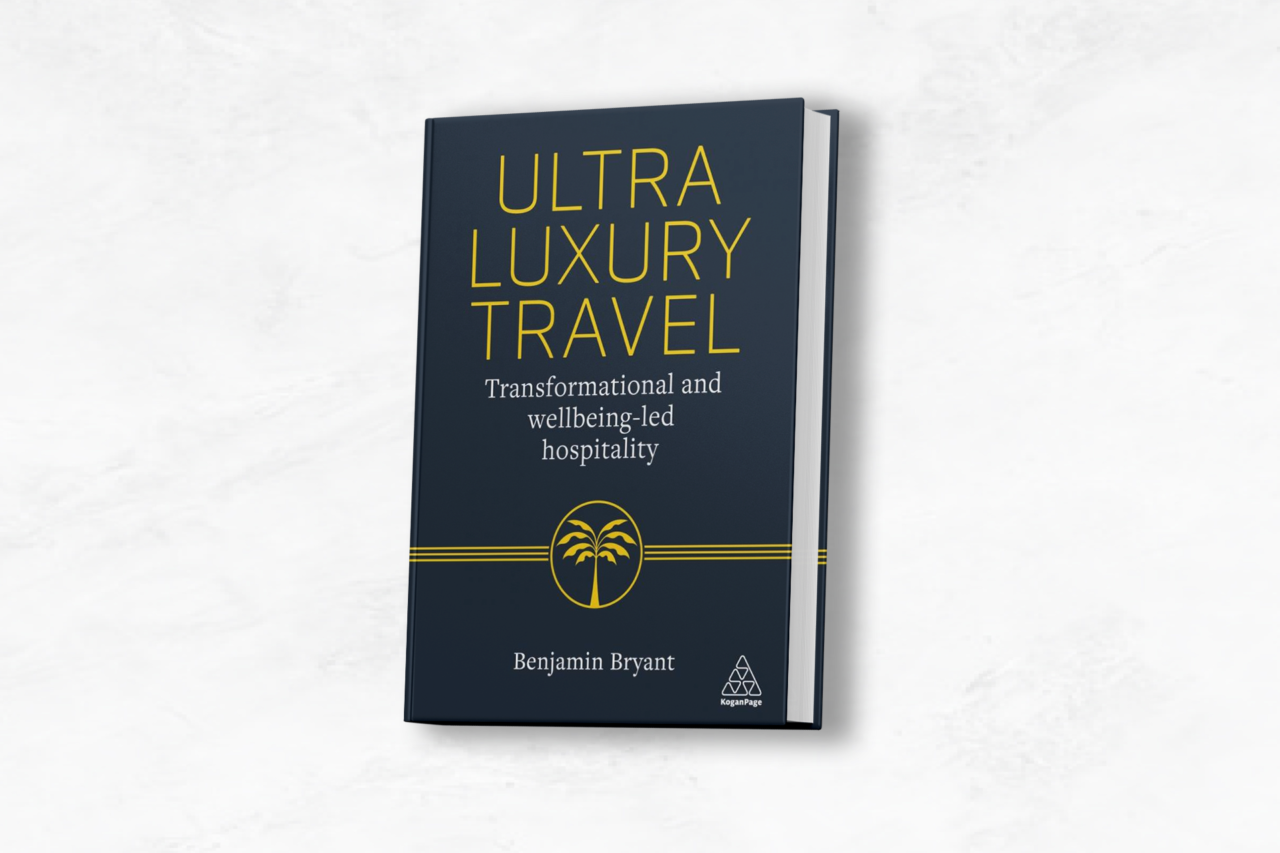
Author: Benjamin Bryant
Publication Date: 2024
In a moment when luxury is being redefined by intention rather than excess, Ultra-Luxury Travel by Benjamin Bryant arrives as a timely and highly relevant read for industry leaders. Positioned not as inspiration, but as a practical blueprint, the book speaks directly to executives, investors, and decision-makers navigating the evolving landscape of global luxury hospitality.
Bryant’s central thesis is clear: ultra-luxury is no longer about visible opulence, it is about meaningful, wellness-driven, and transformative experiences. This shift is not a trend, but a structural evolution in how value is created and perceived at the highest levels of travel.
Drawing on his extensive experience across more than 65 island destinations and collaborations with brands such as Cheval Blanc and The Ritz-Carlton, Bryant grounds his insights in real-world application. What distinguishes this book is its balance between strategic thinking and operational clarity. It does not simply describe change, it provides frameworks to act on it.
One of the strongest aspects of the book is its focus on ROI in experience-led luxury. In an industry where “experience” is often discussed abstractly, Bryant introduces measurable approaches to integrating wellness, sustainability, and personalization into business models. This is particularly valuable for leaders who must justify innovation not only creatively, but financially.
The emphasis on wellness as a core economic driver is especially compelling. Rather than treating wellness as an add-on, the book positions it as a central pillar of ultra-luxury strategy, one that directly influences pricing power, customer loyalty, and long-term brand equity.
Another notable strength is the discussion around de-risking investment in experiential offerings. Through market intelligence and structured decision-making models, Bryant provides a level of strategic discipline that is often missing in conversations about luxury innovation. This makes the book highly relevant not only for hospitality operators, but also for investors and developers.
From a governance perspective, the book also addresses a critical but often overlooked dimension: how to align brand, operations, and sustainability commitments in a way that is both credible and scalable. This reflects a broader shift in the industry toward accountability and long-term value creation.
For the World Luxury Chamber of Commerce (WLCC) audience, the book aligns closely with the need for strategic knowledge and insight-driven decision-making. As a curated global network focused on business growth, prestige, and high-level intelligence, WLCC emphasizes the importance of understanding not just where the market is today, but where it is heading.
Ultra-Luxury Travel contributes meaningfully to that conversation. It reinforces the idea that future leaders in luxury will be those who can combine emotional intelligence with data-driven strategy; those who understand that exclusivity today is defined as much by relevance and authenticity as by price point.
This is not a coffee-table luxury book. It is a working manual for those shaping the next chapter of the industry. For executives seeking clarity in a complex and rapidly evolving market, Ultra-Luxury Travel offers both direction and practical tools.
Who should read it:
Senior leaders in hospitality, luxury travel investors, brand strategists, and anyone involved in designing high-end customer experiences.
Key takeaway:
The future of ultra-luxury lies in intentional, wellness-driven experiences, and the ability to measure, deliver, and scale them with precision.
Get the book on Amazon.
Stay informed on the future of luxury travel, hospitality innovation, and strategic insights shaping the industry — join the WLCC community of global luxury leaders: https://worldluxurychamber.com/wlcc-community/